
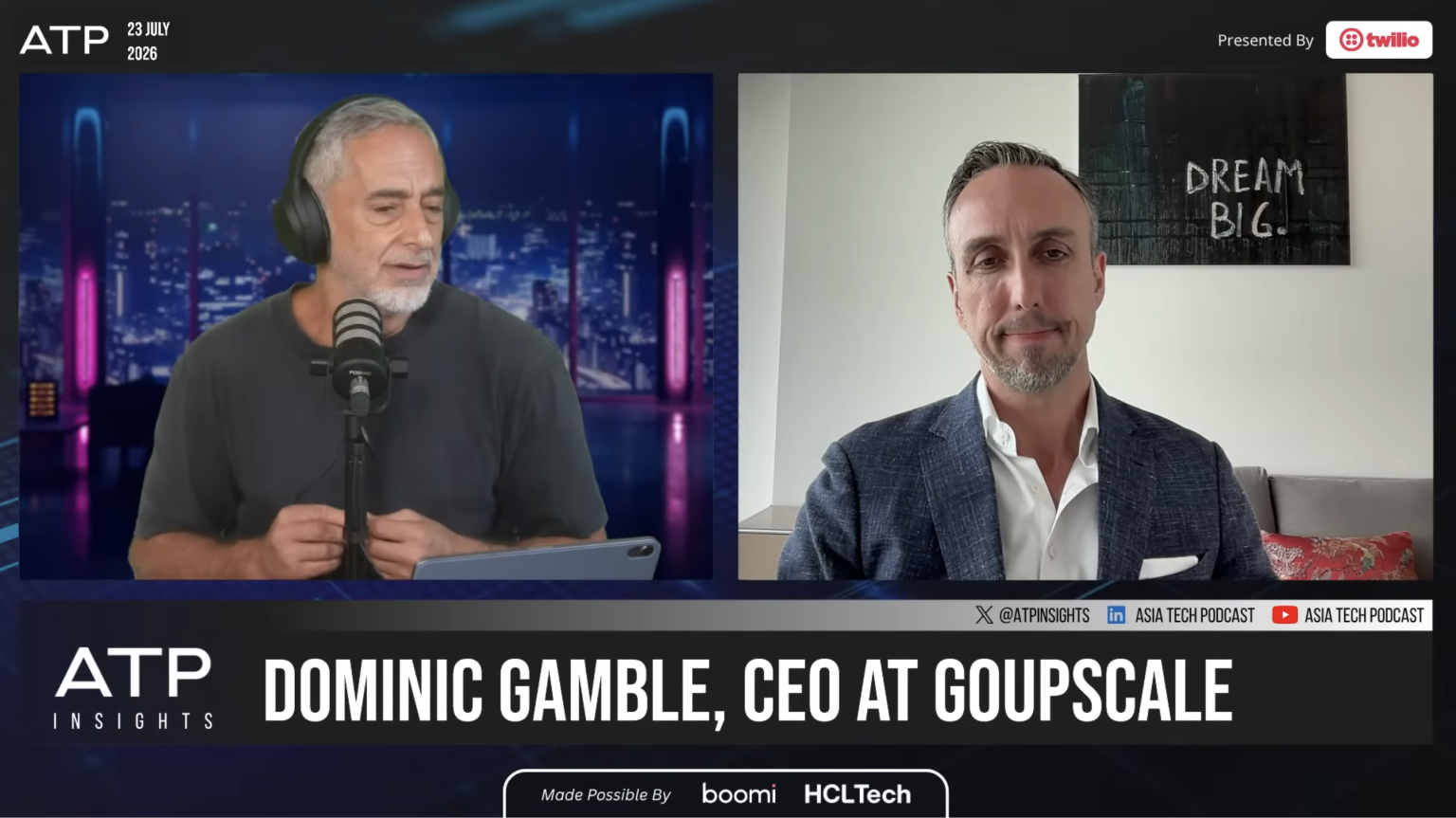
Upscale Co-Founder and CEO Dominic Gamble joined Michael Waitze on the Asia Tech Podcast to discuss how changing content habits, the next generation of wealth and advances in AI are reshaping engagement across financial services.
Wealth and Asset Managers produce enormous amounts of expertise i.e research, investment views, market commentary, product updates and portfolio insights.
But the way much of that information reaches advisors and clients has changed remarkably little.That was one of the central themes when Dominic Gamble, Co-Founder and CEO of Upscale, joined Michael Waitze on the Asia Tech Podcast for a wide-ranging conversation about technology, sales enablement and the future of engagement in wealth management. The discussion explored a challenge Upscale has focused on since its earliest days: financial institutions do not necessarily need more content. They need better ways to turn the expertise they already have into useful, relevant interaction. And as AI accelerates the amount of information organisations can create, solving that distribution and engagement problem becomes more important, not less.
is estimated to transfer to younger generations by 2048 .
Source: Capgemini Research Institute, World Wealth Report 2025: Sail the Great Wealth Transfer

Content consumption has changed and financial services have been slower to follow.
One of Dominic’s central observations during the conversation was that the way people consume information has changed dramatically over the past 10 to 15 years.
Social media, mobile devices and digital platforms have changed expectations around format, speed and accessibility. People are increasingly accustomed to information that is concise, visual, easy to find and available when they need it. Yet much financial-services communication still relies heavily on long emails, large PDFs and relatively static distribution processes. The disconnect affects clients and the people inside financial institutions. Relationship managers, advisors and sales teams consume information in many of the same ways as everybody else. They are unlikely to become more engaged simply because a lengthy document happens to have been produced internally.
As Dominic put it in the conversation, advisors themselves increasingly “don’t want long emails” or large PDFs that are difficult to consume quickly. That creates a simple but important question for financial institutions: If the way people consume information has changed, why should the way financial expertise is delivered remain the same?
Wealth managers are already content publishers
Another important theme in the discussion was the role financial institutions already play as publishers. Wealth managers and Asset Managers may not traditionally describe themselves that way. But much of what they do commercially depends on stories.
An institutional salesperson explaining a private-markets strategy is telling a story. A relationship manager discussing an investment view with a private client is telling a story.
A CIO communicating why the firm’s positioning has changed is telling a story.
The data, research and investment expertise behind those conversations matter enormously. Dominic referenced the observation that the industry has been slow to recognise that financial institutions are, in practice, substantial content publishers. The implication is not that wealth managers should behave like media companies. It is that the formats and distribution models supporting their expertise need to evolve alongside audience behaviour.
Storytelling has always been intrinsic to financial services and the technology supporting that storytelling is now catching up.
Sales teams need better access to their content
This is where sales enablement becomes particularly important.
When Michael Waitze asked what kinds of technology Upscale builds, Dominic returned to the area where the company began. Sales enablement remains at the core of the business.
The underlying objective is straightforward: equip sales and relationship teams with useful content in a form that is easier to access, easier to understand and easier to activate with clients. The challenge for many institutions is not a lack of valuable content, but what happens to it after it is created. Research and marketing materials often sit across different repositories, while advisors rely on email or manual searches to find what is relevant. Teams then spend additional time adapting that content for different audiences and channels, with limited visibility into what clients ultimately engage with. The result is a fragmented journey between institutional expertise and the client conversation.
Modern sales-enablement technology can help connect those steps, making content easier to find, activate and measure. It is this engagement gap that Upscale is built to address. Connecting content, distribution and engagement intelligence so that institutional expertise can move more effectively from the people who create it to the advisors and clients who can use it.
Stay up to date with Upscale
Follow Upscale for company news, partnerships and perspectives on AI, adviser engagement and the evolving wealth management landscape.

The opportunity for AI is bigger than content generation
AI was a natural part of the podcast discussion, but the opportunity Dominic described goes well beyond using generative AI simply to create more content. For Upscale, the bigger opportunity is to help financial institutions use AI-powered content management to strengthen client relationships and improve sales effectiveness. The distinction is important. Creating another piece of content is relatively easy.
The greater challenge is making the expertise that already exists across an organisation easier to transform, organise, distribute and act on. That is where AI can have a more meaningful operational impact.AI can potentially help financial institutions:
Transform complex source documents into more accessible formats.
Classify and organise information; make relevant content easier for advisors to discover.
Support personalisation at greater scale;reduce repetitive content-production work.
Provide stronger signals around engagement.
The technology becomes most valuable when those capabilities are incorporated into real workflows.
That is why Upscale’s work increasingly ranges from relatively straightforward technology adoption through to deeper, longer transformation projects.
The next generation will increase the pressure to change
The conversation also looked further ahead to one of the most significant shifts facing wealth management: the next-generation transfer of wealth. As this gathers momentum over the coming decade, Dominic argued that firms will face growing pressure to rethink how they engage with the clients inheriting that wealth. This is about more than generational preference. Younger clients bring different digital expectations and communication habits, while also having greater choice over where they direct their attention and their assets. Wealth managers cannot assume that the engagement models that worked for one generation will remain equally effective for the next.
That makes engagement an increasingly commercial issue. Firms that continue to rely on legacy communication models risk losing relevance at a time when significant wealth and client relationships are changing hands. For Upscale, this reinforces the opportunity ahead: helping financial institutions evolve how they communicate and engage as the expectations of the clients they serve continue to change.
Regulation matters but it does not explain everything
There are understandable reasons why financial-services content evolves more slowly than communication in other industries. Regulation was another important part of the conversation. Dominic acknowledged the “fear factor” financial institutions face around getting content wrong in the eyes of the regulator, particularly when guidance is not always black and white. That caution is understandable: financial communications require levels of governance and control that many other industries do not. But regulation should not prevent the industry from evolving. Dominic challenged the idea that regulatory complexity alone explains why wealth firms have been slower to adopt shorter, more modern content formats.
Instead, the opportunity is to find better ways to modernise communication within the governance frameworks firms already operate in. Technology has an important role to play in making that possible. Financial institutions should not have to choose between stronger engagement and appropriate control; the right infrastructure should enable both.
Engagement is becoming infrastructure
Taken together, the conversation points to a broader shift in how financial institutions should think about content. Rather than viewing it simply as a marketing output, content is increasingly part of the infrastructure connecting institutional expertise with client relationships and commercial outcomes. Research informs sales conversations, investment ideas support advisor engagement, and client interactions create signals that can help shape what happens next.
As these connections become more digital, the traditional boundaries between content management, sales enablement, distribution and engagement intelligence begin to converge into a more connected workflow. This is the direction in which Upscale is evolving. Sales enablement remains at the core of what we do, but the wider opportunity is to help financial institutions move their expertise more effectively from the people who create it to the advisors and clients who can put it to use.
Staying relevant in the AI era
The question posed in one of the podcast excerpts is a useful way to summarise the conversation: How do wealth firms stay relevant in the AI era? The answer is unlikely to be simply producing more content. As AI makes content increasingly abundant, attention, relevance and effective distribution become more valuable.
The institutions that adapt successfully will be those that make their expertise easier to discover, easier to consume and easier for advisors to turn into meaningful client conversations. Technology can enable that shift, but the objective remains fundamentally human: stronger relationships, more relevant communication and better conversations between financial institutions and the people they serve. Watch the full conversation with Michael Waitze on the Asia Tech Podcast.
Subscribe to our newsletter
A monthly or so newsletter that sums up all our news, tips, insights and observations from the world of sales engagement in the wealth management eco-system.