
Securities brokerages with investment research capabilities invest heavily in specialist analysts, financial modelling and investment insight. Their teams assess company performance, publish Buy, Hold or Sell recommendations, establish target prices and produce research intended to inform investor decisions.
Once published, that research may be distributed through email, research platforms, broker-led client coverage and other approved channels. From there, its commercial influence can become harder to trace. A firm may understand what a report costs to produce, but have a less complete view of whether it reached the right investor, how they engaged with it, what they did next and whether that activity ultimately translated into trading revenue.
Research matters, attribution is the challenge
There is good evidence that investors use research supplied through financial institutions.
Academic research has also found that changes in analyst recommendations can affect stock returns, investor behaviour and sentiment. The question for securities brokerages is therefore not simply whether research has value. It is whether that value is being distributed, consumed and measured effectively enough to connect research engagement with client activity and commercial outcomes.
of surveyed investors used investment research and tools provided by their brokerage or financial advisory firm as a source of investment information.
Source: FINRA Foundation, Investors in the United States, 2025

The distribution model has not always kept pace with the trading experience
The conventional research journey can still be fragmented. An analyst publishes a detailed report, the appropriate compliance and supervisory process is completed, and the research is then distributed through approved channels.In some brokerage models, research also relies on brokers or relationship managers to decide which clients should receive which insights. That human layer can be valuable, but it can also make distribution uneven and measurement more difficult when research engagement sits outside the core digital client journey.
Format adds another source of friction. A compelling investment idea may still arrive as a long-form PDF or email attachment, while the investor's portfolio and trading activity sit inside a mobile or digital brokerage platform. That creates distance between insight and action. Investors’ appetite for digital engagement with their broker has accelerated enormously over the last 10 years. But a broker’s research has not been redesigned for digital consumption.
Investors’ appetite for digital engagement with their broker has accelerated enormously over the last 10 years. But a broker’s research has not been redesigned for digital consumption.

Dominic Gamble
CEO and Co-founder, Upscale
From distribution lists to client relevance
The larger opportunity is not simply to turn a PDF into an article, but make research distribution more intelligent. A brokerage may already hold signals that help establish relevance: current and historic holdings, previous trading activity, exposure to comparable companies, sector interests, watchlist behaviour, recent digital activity and prior research engagement.
Instead of asking: “Who is on the research distribution list?”
The brokerage can ask: “Which clients is this research most relevant to right now?”
That shift matters. Research distribution becomes less about broadcasting content and more about matching investment insight to investors who have a credible reason to care about it.
Personalisation is multi-dimensional
Relevance is only one dimension, but the way research is delivered also matters.
Several themes recur with striking consistency:
Bring research closer to the brokerage experience
Many securities brokerages already have the essential assets: research expertise, proprietary content, client relationships, trading infrastructure and increasingly, behavioural data. The opportunity is to connect them more effectively. Imagine an investor opening a brokerage application and seeing:
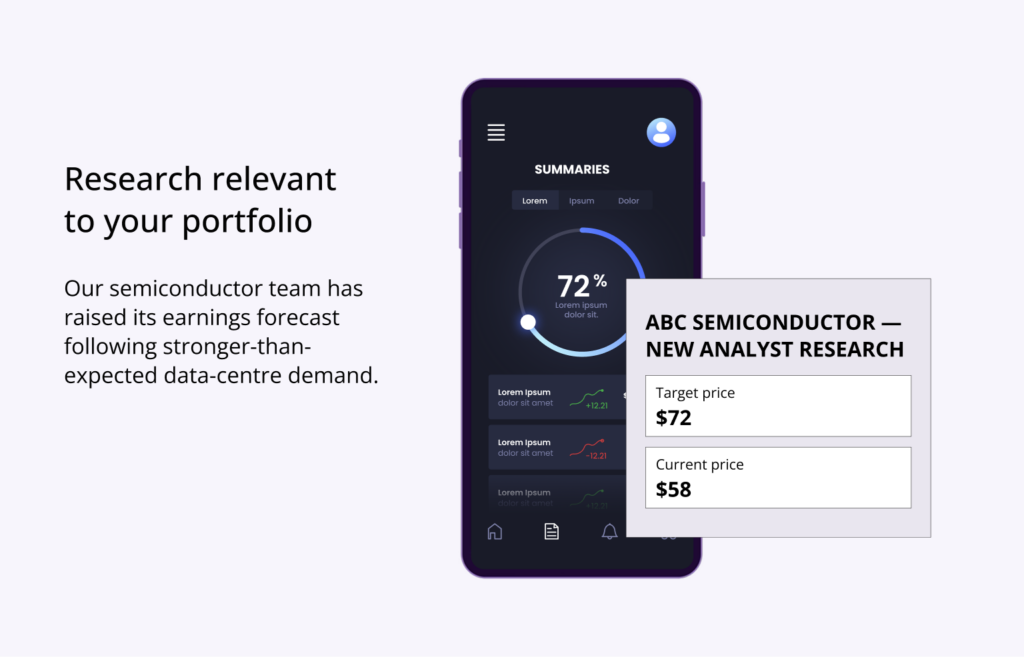
The investor can review the key conclusions, inspect the analyst's evidence, access the full report and view their existing position without leaving the brokerage environment.
Compare that with:
Email → PDF → locate the insight → leave email → open trading app → search security → review position → trade.
Bringing research into the brokerage experience shortens the path between investment insight, portfolio context and the normal trading workflow. It also makes that path considerably easier to measure.
Readership to revenue attribution
Research revenue attribution is the process of connecting engagement with investment research to subsequent client activity and commercial outcomes. In a digital brokerage environment, that creates a measurable journey from research production and audience identification through to delivery, engagement, security views, portfolio checks, order initiation, trade execution and ultimately revenue.
This allows management to understand which research generates the strongest investor engagement, which client segments respond to particular sectors, themes or analysts, and which formats, delivery times and channels perform best.
Firms can also examine whether research exposure correlates with greater security views, order initiation or executed trades, and which research investments are associated with the strongest commercial returns.
The distinction between correlation and causation remains important. A client reading research and then trading a security does not prove that the report caused the trade. Robust attribution therefore requires controlled testing and comparison, such as comparing personalised digital distribution with conventional distribution or concise formats with long-form reports to identify incremental differences in engagement and trading outcomes. The objective is not to claim that research causes every trade. It is to give the brokerage a much clearer view of the relationship between research consumption and downstream client behaviour.
The opportunity for securities brokerage
The industry does not necessarily have a research-quality problem. The greater opportunity lies in distribution, personalisation and measurement.
Brokerages already have specialist research expertise, valuable intellectual property, client relationships and trading infrastructure. Increasingly, they also have the digital signals required to make distribution more relevant and measurable.
The objective is straightforward:
Deliver the right research to the right investor, in the right format, at the right moment and through the right channel then measure what happens next.
The question for the research function can then evolve from:
How many reports did we publish?
to
How much investor engagement, client activity and incremental commercial value did our research influence?
Subscribe to our newsletter
A monthly or so newsletter that sums up all our news, tips, insights and observations from the world of sales engagement in the wealth management eco-system.