
Financial advisors have invested heavily in adviser enablement. Yet one important question often remains unanswered:
What should the adviser actually say, show or send?
Content translates a firm’s investment expertise, product capabilities, market views and planning knowledge into something an adviser can use in a client conversation. Without that layer, even the best technology leaves the adviser responsible for completing the final mile. That usually means searching across multiple systems, adapting an old presentation, writing a client email from scratch or avoiding the conversation until better material is available.
Adviser capacity is becoming a strategic constraint
Productivity is not created simply by installing more platforms however it’s created by the work that stops advisers advising. Among advisers who were not sharing educational content:
Technology identifies the opportunity but content activates it.
A CRM might show that a client is approaching retirement, holding too much cash or relying heavily on a single stock. Moreover, analytics can highlight the opportunity whilst a workflow tool can prompt the adviser to act.
But neither tells them how to have the conversation. The adviser still needs a clear explanation, relevant questions, a useful visual and an approved follow-up. They may also need supporting investment insight, planning guidance and the right disclosures. Without that material, the opportunity is visible, but difficult to act on. This is why content should not sit on the sidelines as a marketing output. In an adviser-led business, it is part of the infrastructure that turns client data into meaningful engagement.
Content helps turn expertise into trust
Research published by the Financial Planning Association found relationships between providing the education clients wanted, connecting advice to personal goals, and stronger levels of trust, satisfaction, cooperation and commitment.
A CFP Board study found that 87% of respondents trusted financial advisers for financial information, compared with 37% who trusted AI and 25% who trusted social media. Respondents also became more comfortable acting on information from AI or social media when it had been verified by a financial adviser.
The opportunity is therefore not to replace the adviser with content or AI. It is to help the adviser interpret, validate and personalise information more effectively.
The industry does not need more content
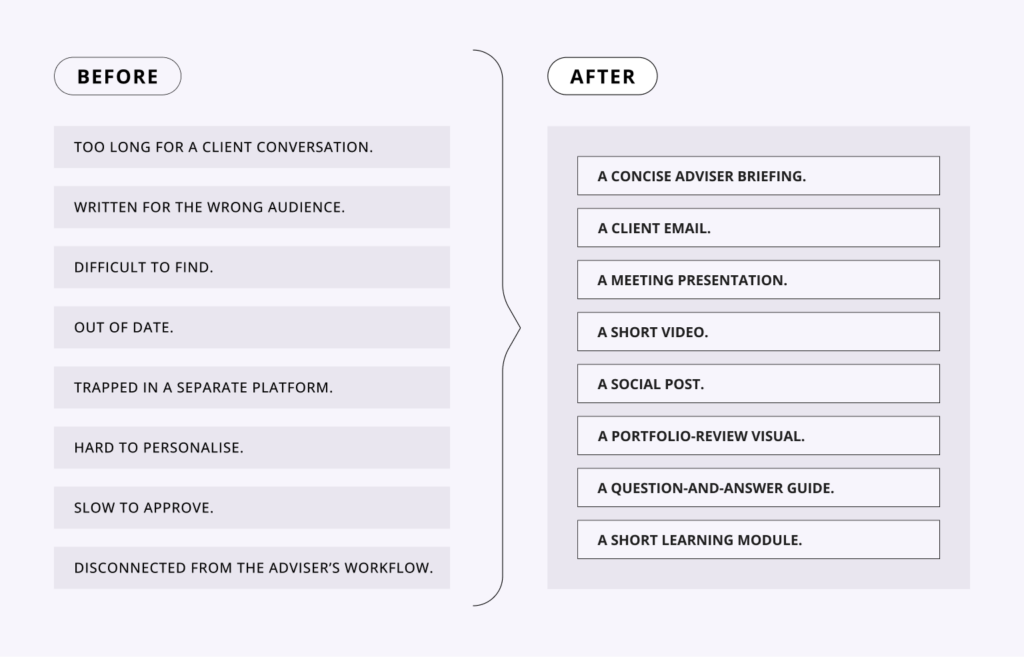
Most financial institutions are not suffering from a shortage of material. They already have investment outlooks, fund commentaries, fact sheets, webinars, presentations, product guides, training modules and compliance documents. The problem is that much of it is not usable at the point of need. This creates a familiar contradiction: the institution produces more content than ever, while advisers still struggle to find something useful to send. That is why the objective should not be greater content volume. It should be content activation.
Better content operations can release measurable capacity
Several Wealth and Asset Management organisations have already reported meaningful productivity improvements from modernising their content processes.Ameriprise Financial reported a 70% reduction in relevant administrative tasks after automating the creation and personalisation of client-meeting content within Salesforce.
Legal and General Asset Management reported saving more than 10,000 hours each year after centralising content and improving controlled presentation assembly. AllianceBernstein reported approximately US$1.8 million in efficiency savings from content automation and Salesforce integration. EFG Asset Management reported reducing its commentary and approval process from 15 days to five days, alongside a 60% improvement in time to market.
While these are vendor-published case studies and should be viewed as directional rather than universal benchmarks, they highlight an important shift in how content should be measured. Instead, firms should look at the operational and commercial impact content creates, including reductions in adviser preparation and search time, faster approval processes, greater content reuse, less administrative effort, improved speed to market, higher adviser adoption, stronger client engagement and, ultimately, more opportunities progressing through the sales pipeline.
Compliance should become an enabler, not a bottleneck
Investment performance, product comparisons, testimonials, social communications and personalised material may all carry different regulatory requirements. The answer is not uncontrolled AI generation or unrestricted adviser editing but it is what’s called ’bounded personalisation’.
In this model, product information remains controlled, approved claims are reused rather than rewritten, disclosures are applied automatically and advisers can personalise only predefined sections. Every piece of content has clear ownership, governance and distribution through approved channels, while AI-generated drafts are created from trusted source material and remain subject to review. This shifts compliance from reviewing every asset from scratch to focusing on approved components, controlled variables and higher-risk exceptions, making the process both faster and more consistent.
What a modern content-enablement model looks like
A strong model brings content into the adviser’s daily workflow. When the adviser prepares for a meeting, the system should surface the relevant talking points, client materials and follow-up options automatically.
When markets move, advisers should receive a ready-to-use communication package rather than search across several internal sites. When a client approaches a life event, the CRM should connect the opportunity with approved educational material and suggested next steps. The underlying model can be summarised simply:
Client signal → relevant insight → approved content → adviser conversation → measurable action.AI can improve search, summarise approved research and recommend relevant content, but it cannot fix poor content foundations.
If information is outdated, duplicated or poorly governed, AI will simply amplify those issues. Effective AI starts with trusted, well-managed content.
Content is the execution layer of adviser enablement
The industry has invested heavily in the systems that support advisers. The next step is improving what happens between the insight and the client conversation. That means giving advisers content that is easy to find, relevant, approved and ready to use within their workflow. CRM identifies who to contact, analytics explains why the conversation matters, training builds confidence, and content helps advisers turn insight into meaningful engagement.
Subscribe to our newsletter
A monthly or so newsletter that sums up all our news, tips, insights and observations from the world of sales engagement in the wealth management eco-system.